


How to handle pressure in PTE Listening? How does LIT work? Learn with the best PTE training institute.

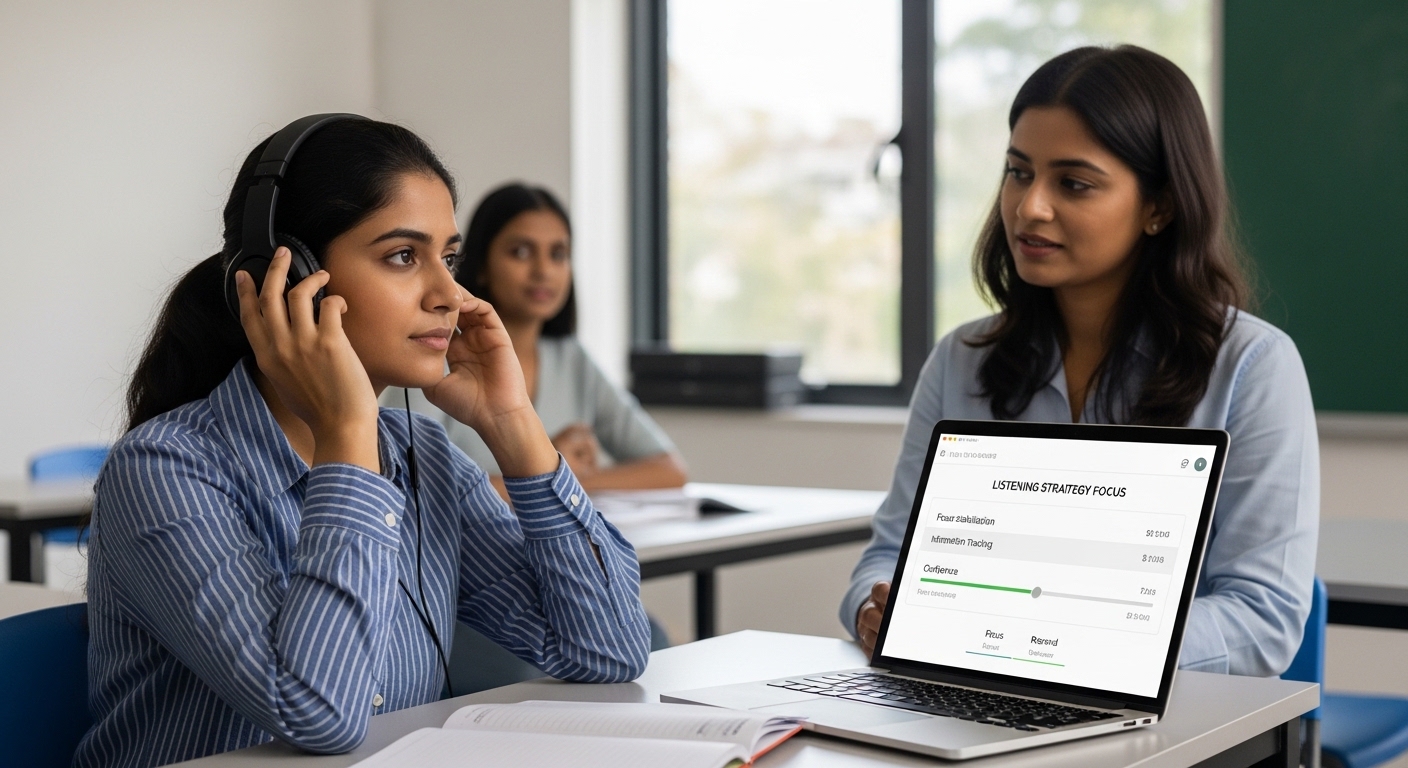
In the PTE exam, the listening section is an important area that requires more focus. The PTE Listening section is not just about hearing words; it is about the mental capability to process fast audio information under intense time pressure. Many aspirants mistakenly rely on guesswork to complete this module, but true success comes from sharpening the students' auditory processing. It measures how effectively they interpret the given spoken information and how they analyze it.
Many students face difficulty while doing listening tasks. One of the problems is interpreting the given audio. To solve this issue, I introduced a groundbreaking technique, which is termed the LIT Technique, to reorganize the listening module preparations. This activity-oriented strategy is a transformation from passive listening, empowering candidates to engage deeply with complex audio without the constraint of constant digital consumption. Learn with the best PTE coaching centre.
“You can’t Learn if you are not actively Listening” – Stan Sunny
What types of tasks contribute marks to Listening?
Tasks that contribute marks to the Listening section consist of,
1) Summarize spoken text: Listen to the lecture and write a brief based on the audio within specific word counts.
2) Write from dictation: Listen to the sentence or statement from the audio and write down what you hear.
3) Highlight incorrect words: Highlight the words mismatched with the audio. Should focus on negative marking.
4) Fill in the blanks: Fill the blank space in the given script with the proper word listen from the audio.
5) Select the missing word: Select the missing phrases with the given options that relate to the audio.
6) Highlight the correct summary: Listen to the audio and select the suitable summary of the audio.
7) Multiple Choice, single answer: Choose a single option related to the topic you listen to.
8) Multiple Choice, multiple answer: Choose more than one option based on the topic listened to from the audio.
There are certain tasks from the speaking module that contribute marks to the listening section, such as
1) Repeat sentence: After listening to an audio, repeat the sentence or statement you hear from it.
2) Retell the lecture: Retell the lecture after listening to the audio.
3) Answer short question: Answer in a single word or a few words after listening to the question from the audio.
4) Summarize group discussion: Listen to the discussion among more than 2 people and summarise it within a specific time.
What are the common problems students face in the PTE Listening module?
There are certain problems that faced by students while doing tasks in the listening module, such as
* Fast audio with unfamiliar accents: PTE audio has a variety of accents, including British, American, Australian, Canadian, Indian etc. Speaking quickly makes it hard to understand everything, which can lead to anxiety.
* Time constraints while note-taking: During lengthy audio segments, it is common to lose focus. It is difficult to remember important details when you do not take notes for certain tasks.
* Negative marking and overthinking: Making too many guesses during exams might result in negative marks, which lower the final score.
* Distractions in the test centre: Practice in noisy environments is necessary because the noisy atmosphere and other people's conversations can cause distractions.
What is the LIT technique?
The LIT (Listening Interpretation Technique) approach is a comprehensive transformation framework that treats listening as a sophisticated cognitive activity, as opposed to a secondary ability. It serves as a bridge between auditory information and significant insights. The LIT method is created as an interactive, task-oriented exercise where students apply what they have been taught.
LIT is practiced through controlled listening exercises that replicate the challenges of the PTE. It helps students eventually develop mental tolerance, which enables them to concentrate on lengthy audio tasks. This method ensures that students not only comprehend English but also know how to respond appropriately in stressful PTE exam situations.
Why does the LIT technique have Significance?
* Analyzing the scene: Analyze the circumstances of the message heard from the audio and relate it to real life situations.
* Paraphrasing : Restating the audio in your own words to ensure that your understanding aligns with the speaker's intention. It is important for content scoring.
* Detecting key elements: Recognizing transitional words that assist you in interpreting how the communication is constructed and logical flow is maintained. Coherence and cohesion matter in exams.
* Summarizing the idea: Identifying and detecting the main points from a long audio to ensure that the key ideas are retained. After that, summarize it in your own words.
Why does Tiju's Academy apply this technique? What are the benefits for candidates?
* Content-oriented listening approach: By focusing on concepts rather than specific words, students can improve accuracy and reduce overload.
* Create predictive attention: By enabling students to foresee the main elements of audio, it helps them stay vigilant and prepared.
* Response sorting ability: Not all of the audio is significant. Students are trained to quickly recognize scoring keywords and ignore irrelevant content.
* Enhances retention of information: Active listening encourages the brain to encode information into memory more successfully than passive listening.
* Develops analytical ability: It allows students to organize and evaluate the tasks, seeking clarification when they do not understand a concept.
Conclusion
Listening requires more attention and focus. Securing a high score in the Listening module is often a big hurdle for certain students due to different audio accents and the pressure of a computerized format, making it a daunting one. The LIT technique is designed as a solution for this problem. The transformative LIT technique enables the students to approach the listening module in a different way. As a trainer, I developed this technique to cover the gap between what the student hears and what they interpret to get a high band in Listening tasks.
The LIT technique is leading the way by redefining PTE exam preparation with a tactical approach. Ultimately, it changes the way the students approach the test, enabling them to control it instead of only hearing it. To know more, join the best leading PTE offline and online coaching academy.
Frequently Asked Questions (FAQs)
1. Are listening tasks simple or complex?
Listening tasks are entirely based on the audio. This module is simple for certain students and difficult for some others. However, the score depends on how you interpret the audio.
2. How does the LIT technique work in this module?
Proper interpretation of audio is necessary to complete the tasks in the listening module and secure a high score. The accent of the audio you listen to is different. So, proper guidance is required to answer this type of task. Here, the LIT technique works better by teaching the students how to comprehend the audio.
3. Do the listening tasks only contribute marks to the listening module?
Actually not. You can gain the score not only from the tasks in listening but also from certain tasks of the speaking module.
4. What are the main tasks in the Listening module?
There are eight tasks in the listening module. Summarize spoken text, fill in the blanks, write from dictation, highlight Incorrect words, select missing word, highlight correct summary, multiple choice single answer, multiple choice multiple answer. Out of these tasks, summarize spoken text, fill in the blanks, write from dictation, and highlight incorrect words have more weightage.
5. Are tasks different for PTE academic and PTE core?
Tasks are remaining the same for both PTE academic and core except for one task. Highlight correct summary task is not included in the PTE core listening. However, certain changes are there regarding the time and word counts.
6. Can I use the extra time that I saved from other modules?
No. You can’t use the extra time saved from any other modules because the time is fixed for each part. You can use only the specific time allocated by Pearson. But you can leave the test center if you complete the exam earlier.
7. What accents will there be in the listening exam?
You can expect different accents of audio in the PTE exam. Different modulations and paces of audio were included in the exam. Mostly, you can expect Canadian, Australian, British, American, and German accents of English.
8. What is the minimum score required in the PTE exam?
It depends on the aspirant requirements. If you plan for studies then you need a score specified by the universities, and it may vary as per country. If you plan for immigration, the required score is based on your age and experience. However, overall as well as individually, 65 is a par score that allows you to apply for both immigration and study purposes.
9. Is the LIT technique based on an activity-oriented approach?
Definitely, the LIT strategy is an activity-oriented approach that enables students to build comprehensive skills based on active listening. It enables them to develop concentration and interpretation of given data easily.